
Imagine you are about to approve a swap on a new AMM on Arbitrum while holding assets across Ethereum and Polygon. The dApp asks for an approval and a signed transaction; a single mis-signed tx could drain tokens, or a hidden approval could give a malicious contract permission to transfer funds later. For power users — traders, LPs, arbitrageurs, and operators managing multiple addresses — the cost of “blind signing” is not just a failed trade: it is a hard security boundary crossed. Transaction simulation, when integrated into the wallet rather than left to the dApp, redefines that boundary by making the wallet an active risk filter rather than a passive signer.
This explainer dissects how transaction simulation works in practice, why it matters for multi‑chain workflows, and where simulation helps — and where it cannot protect you. The analysis is grounded in practical mechanisms, trade-offs between safety and friction, and decision-useful heuristics for choosing a wallet if pre‑transaction inspection is a priority.
Mechanics: what exactly is transaction simulation?
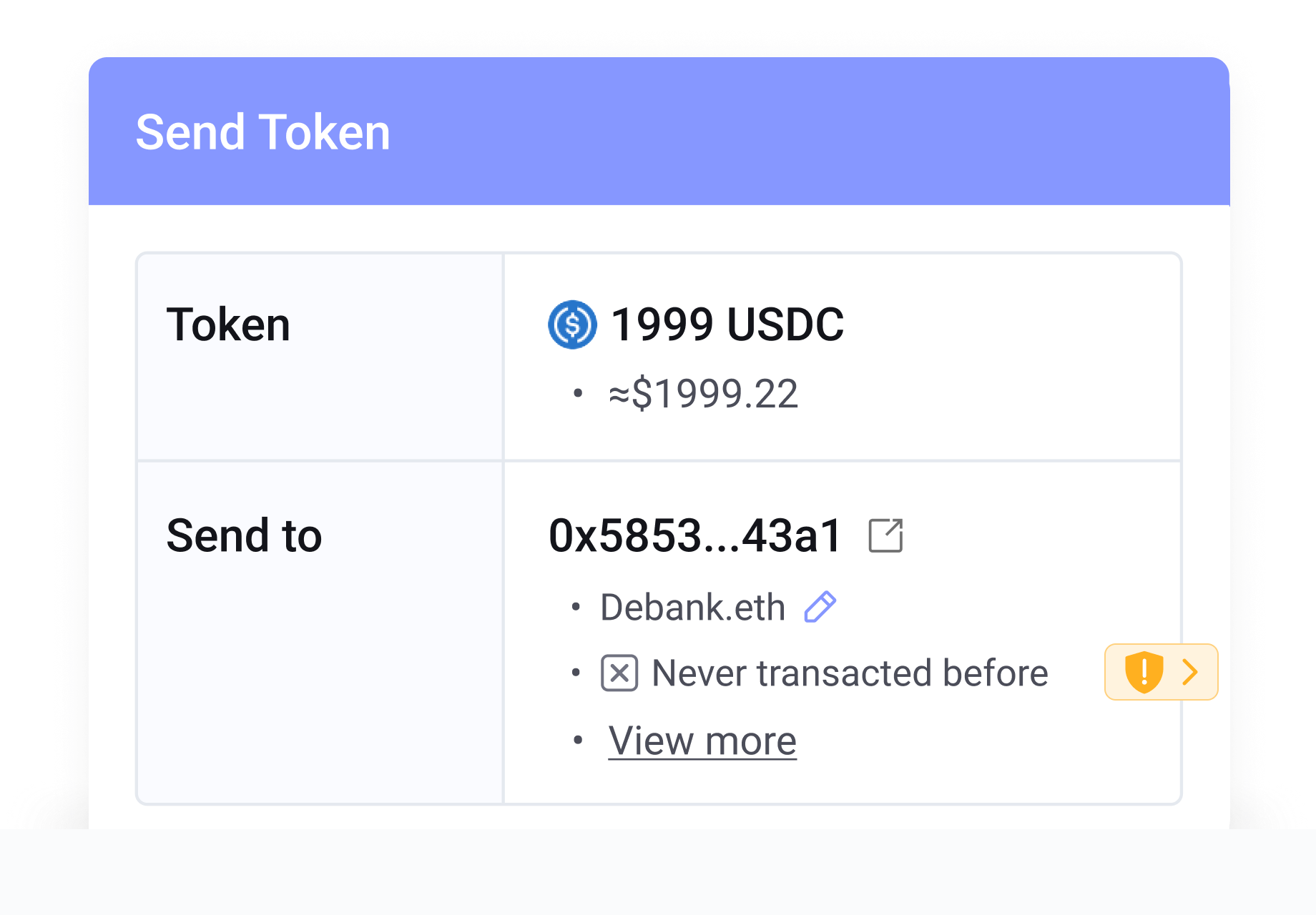
Transaction simulation executes a proposed transaction locally or on a read-only node to compute its effects without broadcasting it. At minimum, a simulation returns estimated gas cost and resulting token balance changes. A richer simulation also traces internal calls, identifies token approvals invoked or consumed, and exposes interactions with other contracts such as routers or permission managers. In practice the wallet constructs the same call data the browser would sign, runs it in a simulated EVM environment against the current chain state, and surfaces a human-readable summary before signing.
For multi‑chain wallets the simulation step must be network-aware: it must run against the correct chain state for Ethereum, Arbitrum, BNB Chain, etc. Automatic network switching can make that transparent to the user; absence of such switching forces manual context checks, which are an operational source of errors. Rabby’s design bundles simulation with automatic network detection and an on‑screen summary of token and fee changes, turning a low‑visibility technical call into an explicit decision point for the user.
Why simulation matters: three security mechanisms
Transaction simulation reduces three classes of risk. First, it prevents blind signing by showing projected balance deltas: you see “you will lose 10 USDC and pay 0.003 ETH” before approval. Second, it exposes unexpected approvals and allowance resets which are a common exploit vector. Third, combined with a pre‑transaction risk scanner that checks contract reputations (hacked history, code anomalies, suspicious recipient addresses), it provides a layered, defense‑in‑depth control at the user’s endpoint.
Layering matters: simulation is not merely cosmetic. It changes incentives for both attackers and users. Attackers now need to craft transactions that look benign in simulated state snapshots or trick users into switching to a malicious RPC endpoint. Users gain time and evidence to refuse suspicious requests. These shifts do not eliminate risk but they raise the cost of successful social engineering or low-sophistication contract exploits.
Where simulation breaks down: limitations and boundary conditions
Simulation is powerful but not omnipotent. First, it is only as accurate as the state snapshot and RPC provider used. If a wallet simulates against a stale or attacker-controlled node, results can be manipulated. Second, simulation cannot predict off‑chain logic or future states: an on‑chain call that depends on price or oracle updates may behave differently when mined. Third, simulation can be fooled by highly obfuscated or proxy-based contracts; tracing internal calls has limits when contracts deliberately hide behavior behind delegatecalls and opaque libraries.
Operationally, simulation introduces latency and occasional false positives. A wallet that blocks or warns on many transactions can frustrate high-frequency workflows; conversely, a permissive wallet undermines the safety benefit. There is a trade-off between aggressive blocking and user autonomy. The right balance depends on your risk tolerance and operational needs.
Comparative trade-offs: Rabby and the wallet landscape
In the EVM wallet space, common choices include MetaMask, Trust Wallet, and Coinbase Wallet. Rabby differentiates itself by integrating transaction simulation and automatic network switching at the wallet level, plus native approval revocation and a pre-transaction risk engine. For power users managing multi‑chain positions across more than 90 EVM networks, those features are not mere convenience — they are practical risk mitigations that reduce human error across chain contexts.
Institutional operators should note Rabby’s compatibility with multi‑sig and custody providers (Gnosis Safe, Fireblocks, Amber, Cobo Wallet). That matters because wallets that play well with multi‑signature workflows allow security teams to retain operational controls while benefiting from simulation. Rabby’s open‑source MIT codebase also enables independent audits — an attractive property when institutional compliance or internal review is required.
But remember the 2022 incident where a Rabby‑associated smart contract was exploited. The team responded with freezes, compensation, and stronger audits. This episode is evidence that even wallets with strong endpoint defenses must watch their ancillary smart contracts and integrations. Simulation helps at the signing boundary but cannot substitute for rigorous contract design and third‑party audit practices.
Decision heuristics: choosing a wallet when simulation matters
Here are practical heuristics to operationalize the above trade-offs as you evaluate wallets:
1) Prioritize endpoint simulation if you frequently interact with novel contracts. If you routinely sign approvals or trades on new dApps, a wallet that simulates transaction effects and makes approvals explicit will materially reduce risk.
2) Check RPC hygiene. Prefer wallets that default to reputable public RPCs or let you pin private providers; avoid wallets that allow unnoticed RPC switching by sites. Simulation against attacker‑controlled RPCs is a false comfort.
3) Use hardware and multi‑sig for high balances. Simulation reduces human error but does not replace the security provided by hardware signing devices and multi‑party key control.
4) Balance friction and speed. If you are an arbitrageur, simulation latency can cost opportunity. Consider a workflow where high‑value or one‑off approvals require simulation, while repeated low‑value operations are batched under stricter allowances.
Practical next steps and what to watch
If you want hands‑on testing, try workflows that typically fail: allowance increases, token approvals via proxies, swaps with slippage changes, and cross‑chain gas top‑ups. Observe how the wallet reports balance deltas, internal calls, and flagging of risky addresses. For U.S.-based users, also check whether fiat on‑ramp absence matters for your UX; Rabby currently lacks a native fiat purchase option, so plan custody and funding accordingly.
Signals to monitor in the near term: improvements in RPC decentralization (which reduce the risk of manipulated simulation), richer provenance databases for contract reputations, and tighter hardware wallet integrations that let simulations drive explicit hardware confirmations. Each development would strengthen the value proposition of in‑wallet simulation as a systemic safety layer.
FAQ
Does transaction simulation prevent all smart contract exploits?
No. Simulation reduces risk at the signing moment by revealing immediate effects and suspicious calls, but it cannot prevent exploits that rely on delayed oracle updates, reentrancy triggered by concurrent transactions, or bugs in externally deployed contracts. Treat simulation as one element in a defense‑in‑depth strategy that includes hardware wallets, multi‑sig controls, audited contracts, and conservative allowance practices.
How does automatic network switching affect security?
Automatic network switching reduces a common human error — signing on the wrong chain — by moving the wallet to the correct network when you visit a dApp. That lowers friction and confusion, but it requires the wallet to enforce correct RPC endpoints and avoid being misled by sites that attempt to spoof chain identity. Verify that the wallet shows clear chain context and reputable RPC usage.
Can simulation be faked by an attacker?
Potentially, yes. If the simulation runs against an attacker‑controlled node that reports a manipulated state, the summary can be misleading. Mitigations include using trusted RPC providers, deterministic local state caching, and cross‑checking with alternative providers. Open‑source wallets make it easier for independent auditors to verify simulation integrity.
Is simulation compatible with hardware wallets and multi‑sig?
Yes. Wallets that integrate simulation should still support hardware devices like Ledger and Trezor and multi‑sig flows through services such as Gnosis Safe. The simulation provides a clear summary that signers can review on-chain before they physically approve with a hardware device or a co‑signer. That combination is a strong operational pattern for high-value accounts.
For power users seeking an integrated approach to pre‑transaction inspection, consider a practical test: import one of your non‑critical wallets into a browser extension that emphasizes simulation, try several real but low-value approvals across different chains, and record whether the wallet’s summary matches on‑chain outcomes. If you want to examine a wallet that embeds simulation, automatic network switching, and a visible approval revocation tool, see rabby and evaluate it against the heuristics above.
